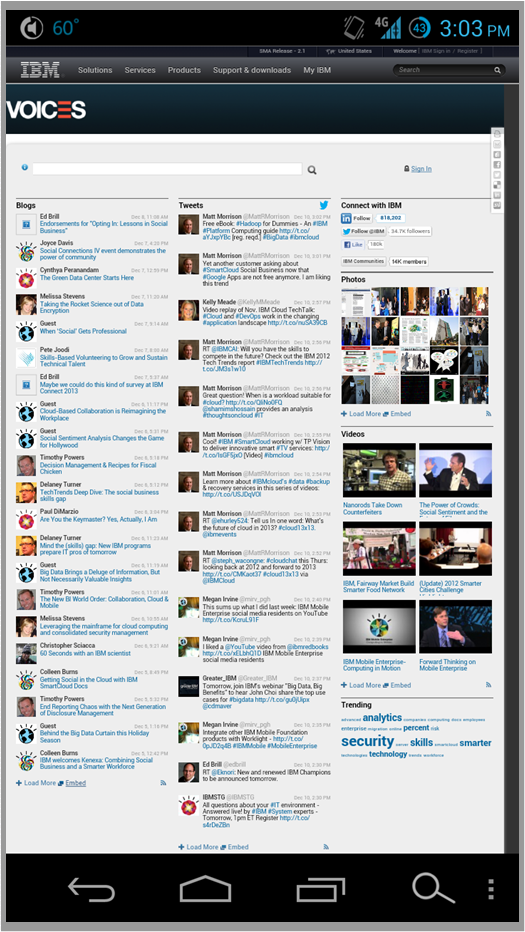
Screenshot of IBM.com/Voices running on a mobile device
Organizations that allow and encourage individuals/employees to become comfortable integrating their personal and professional personae aren’t getting enough press. That is to say, we are all experiencing the convergence of organizational brand & culture with personal identity that is unprecedented — and the organizations that will win in this era of greater data transparency, permanence, velocity and discoverability will be those that can attract and retain people who improve company culture by embodying the company’s character. Essentially, social brand strategists need to create intentional systems of engagement that share benefit with employees and allow these individuals to contribute positively to how the brand is experienced. Naturally, this is especially true for business to business firms. It might even be a no-brainer when we look back one day.
One externally visible representation of this strategy in action is www.ibm.com/voices where we have begun to experiment with a data service (rendered there on a web page pretty simply) that combines our “official channels” with those of some of IBM’s subject matter experts. This juxtaposition of the individual IBMer’s expertise and the official channel content seems to have an overall improving effect — for the brand channels, you get additional legitimization because they’re right there with individual people. For the IBMers, they get the credibility of being in this special data service (which leads to more exposure etc for them.) We have been building out the criteria, guidelines, registration systems, training etc on the back end for this for a while — but more importantly, we can do this because at IBM we have been working a long time on creating a values-led culture, which somewhat mitigates risks and tends to improve the likelihood that the quality of the interactions will be good (thus obviating decreasing the need for micro-management).
I think this all indicates a new value exchange emerging between employees and firms — authenticity for credibility — and it can flow bidirectionally depending on the context.
How many times have you heard your social media or digital campaign described with vocabulary borrowed from a field commander? Even the term “campaign” has a distinctly military connotation.
Just the other day I participated in a webinar where the social media ‘expert’ describing his program used the following phrases in less than 15 mins:
“boots on the ground”
“battle for mindshare”
“the enemy”
“attack the competition”
“laser focus”
“Shotgun approach”
“social media bootcamp”
“Trojan horse”
“turning the battleship”
Referred to employees as “troops”
And it wasn’t just this one guy…I hear this language of war applied all the time to marketing and communications….”battle for hearts and minds” “on target” “crusade” “tip of the spear” etc etc.
I find it particularly disturbing because so many people in our field overtly declare themselves passionate advocates — and even evangelists — for doing things in new, social, highly collaborative, inclusive and innovative ways. The whole war-as-metaphor seems like a colossal miss.
I am all for spirited competition and passion in our work, but can we agree to try to give the war words a rest? Heck, I will take impenetrable marketing lingo over jingoistic jargon any day. Leverage THAT synergy, pal.
I was invited to speak at LinkedIn TechConnect 2012 and they posted the following video of the session I was in moderated by Mike Weir, Head of Category Development, Tech Sector, Marketing Solutions, LinkedIn and featuring Rishi Dave, Executive Director, Enterprise Solutions & Business Digital Marketing, Dell and Maria Pergolino, Senior Director of Marketing, Marketo.
Apologies in advance for the form (looks like LinkedIn may be harvesting some email here…no doubt well worth it!)
When it comes to making the enterprise workplace more digital and social, I don’t think we’ve made it clear enough what behaviors are expected around the roll-out of just about any kind of interactions in digital media…we’ve relied too heavily on institutional inertia which has a kind of gravity towards the lowest common denominator in many cases.
What if you were launching something called “Anonymous Business” instead of social business? What would you do…activate evangelists and coaches and create online tutorials about how to be anonymous and and antisocial while at work? “Top tips for ignoring your colleagues’ contributions” “Six easy steps to sending emails from system IDs with incomprehensible instructions”
My point with the silly example is that in absence of definitive behavioral signposts, you have essentially done the alternative.
Meanwhile, there are alternatives…though we haven’t really made it happen yet. I remember someone telling me about a sign that was up (may still be) in every single Intel meeting room, including the board room, that listed steps for productive meetings (a bit of googling and here’s a link) Talk about pervasive, contextual cultural signals! Can you do something like that in the context of your company’s digital toolset? Not just offer how-to instructions, but cultural signposts as well?
We’ve applied some light gameification to some of our how-to guides and enablement materials for the adoption of social business tools and platforms. It’s not much a cultural signpost yet, but I think there’s potential.
Does anyone have examples of behavioral signposts in the context of digital systems?
Nope, it’s not the dancing twins. (Though that is a pretty awesome viral video too.)
Over the weekend one of my colleagues at IBM sent me a link to a video from “The Ugly Indian” and immediately I thought “Oh brother, here’s someone who wants to comment negatively about my company’s presence internationally.” But I was pleasantly surprised.
It turns out that the Ugly Indian is an organization that encourages Indian citizens to take responsibility for how their country looks (locally) and their environmental impact (globally.) They organize “spot fixes” by partnering with various corporations to mob a particularly dirty area in the streets of India and clean it up, repaint it, plant new plants etc.
I am traveling a few weeks to speak at AdTech in Bangalore…and I plan to visit the site of this clean up as part of my trip!
So here’s the video and, below it, a bit of background information sent to me by my colleague, Deepa Kedoor, in India when I asked for more detail.
“This started off with a ” Say No to Plastic” oath and to to determine if there is something we could do, that would really impact from a grass root level. i.e reduce the use of plastic just by doing an activity. instead of going on a sermon mode.
This is where we thought of partnering with “The Ugly Indian.” This group works with Corporates to clean office spaces and educate vendors around the area, on reduced use of plastic, and promote a plastic free environment. The group has done some incredible work with Dell, ING Vysya and many other such corporates and have a great following on social Media. The thought behind this was that if we were to create a really clean space outside our main offices in Bangalore, then employees would …keep it clean and not litter it with plastic and cigarette butts etc..
We approached them to do the activity with us at Subramanya Arcade, This has stemmed from employees who have posted comments on our ‘ Say No to plastic’ article on W3 <IBM’s intranet> stating that they would like to clean up their campuses, and get rid of the plastic in the office spaces. This is being run with the support of On Demand Community volunteers by the Corporate Citizenship & Corporate Affairs Team.
On this day about 60 volunteers came out to help run this effort.
This event was kicked off by our COO Amit Sharma…. and we plan to have this drive at other locations as well”..
Just read “Why you shouldn’t train employees for security awareness” @Computerworld and found the perspective interesting, though clearly biased. Obviously, the author is the CEO of a company that sells security solutions, so that explains the bias… But the article actually brings into focus, for me, anyway, the need for organizations to take BOTH technological measures to protect against cybercrimes and employee training. Fact is, training employees to understand how to protect themselves and the company from cybercrime can be either awfully or in a way that creates a culture of vigilance. You want to be in the latter camp, for sure.
My grandfather, a NY City detective, used to say “There is no lock that will stop a determined thief.” While that may have been true when he was on the beat in the 1930s, it is even more true today. You cannot rely solely on technology to protect your company — your people need to be trained to enforce security policy, recognize threats and embrace a culture of healthy vigilance.
So sure, take active measures to segregate and secure data, actively monitor for threats, classify users and access to systems etc etc. But also prepare your people for the digital, social media connected world too.



 Ethan McCarty