Two articles with Drew Neisser from FastCompany

I did an interview with Drew Neisser a couple weeks back for a piece he was writing for Fast Company and a study he’s doing — he’s interviewed about 100 social media peeps from a bunch of firms around the world in service of a broad social media survey.  In the mean time, he published this summary article of the Social Media Fitness Report.  He also took the interview I did with him and posted it to The Drew Blog.


More blur…personal and professional

One major point of “blur” between personal and business is the BYOD (bring your own device) phenomenon that is driving major shifts in IT policy, investment and workforce policy.  In a nutshell, you have a preponderance of people using their own devices to do work rather than using the device that the IT department assigns to them.  This means the intensely personal relationship clients, employees and partners now have with their devices (overwhelmingly mobile) reinforces the expectation that interactions with your company will be not only be equivalently personal as the other “apps” they have on the device, but that the design and user experience will meet or exceed the experience offered in consumer apps.

Here is a terrific article on the topic BYOD and the new API border for the enterprise published this week by GigaOm analyst Matt McLarty.  http://www.ow.ly/aalrz

This BYOD phenomenon will drive both the API-iffication and the App-iffication of the enterprise — meaning the digital experience that our customers, employees etc will expect will be web-services-driven, recombinant by the end user and tailored not only to them as individuals, but to their favorite device’s capability.

Just look around in your next meeting and see how many people have multiple devices (personal vs professional) and how many are just using their own (whether their IT policy supports it or not!)

A little Friday fun: How to boost your Klout score in two simple steps

I am sure Klout and the others in the gang of influence-measuring startups will one day arrive at sophisticated means to gauge influence and determine the topics of influence for individuals…but until then, I offer you all a simple and pleasurable way to game the system. Enjoy 🙂

Boost your influence on Klout!

View more presentations from Ethan McCarty


Social media gardening for the enterprise

A while back I had lunch with Rob Key, who is the CEO of Converseon, and we had a wide-ranging conversation about social media management for the enterprise.  I shared with him an analogy — we’ve let a thousand flowers bloom and now it’s time to weed the garden.  By that I mean a lot of big brands have spent the past few years dabbling in a very disorganized way with social media — often approaching it simply as a low cost channel rather than as a valuable asset that demands cultivation.  And so, they’re left with a chaotic array of abandoned Facebook pages, Twitter IDs, LinkedIn groups and the like. While that period was, I think, a fruitful period of experimentation, it’s time to take some more organized action — the social media universe has matured a bit.  It’s no longer the peripheral domain of nebishy fanboys.

Now it may be different for business-to-consumer brands with popular appeal, but for business-to-business companies I feel strongly that the way to have an effective presence in social media is to accentuate the people in the organization rather than the products.  That said, brand channels are almost a necessary evil — if you don’t start them and manage them well, someone else will do it for you, and likely do it poorly (a fan, a well-meaning employee, a competitor).

So 2012 is the year of applying some rigor to social media management — for both B2C and B2B companies.  This will require developing systems (a combination of governance, technology, people) to actively monitor and optimize the brand channels and individual employee participation alike.

The reason I started this post talking about Rob is that he wrote, I think, a very eloquent riff on the garden metaphor that describes 4 Ways to Bring Discipline to Social Media.  It’s excellent and I recommend it to you.

Yeah, you.

Social Media Week Shines a Light on Social Business

This week the digerati and the everyday netizen alike will look up for a moment from their laptops and smart phones to focus their eyes on Social Media Week, a worldwide series of interconnected events and activities about emerging trends in social and mobile media across all major industries.

The people who shape the future of our digital lives will share ideas, strategies and insights with an eye towards improving digital experiences for the people and organizations they care about most. While social media has significantly shaped how we communicate and connect in our personal lives, there’s a related trend that the most sophisticated enterprises have already begun to embrace: social business. Engaging in social media through Facebook,  YouTube and the like represent just one element businesses can explore, but business is more than media – so how can businesses apply the principles of “social” to other dimensions of their organizations to improve outcomes?

In today’s business environment, organizations must become more agile, creative and innovative in order to compete. Forward-looking organizations amplify the benefit of human interactions in just about any business process by making them social (as opposed to trying to engineer the human interactions out of the business process, which is the unfortunate legacy of many enterprise systems.) For example, interacting with the sales team of a social business might include benefiting from digital artifacts of human interactions reaching deep into that company’s supply chain or research division. A really sophisticated social business might have friendly and easily navigable visualizations of these artifacts of interactions. So this is to say that social business is a superset of interactions that includes social media — since media is just one dimension of interaction with an organization.

According to Forrester Research, the market opportunity for social enterprise apps is expected to grow at a rate of 61 percent through 2016, reaching $6.4 billion, compared with $600 million last year (“Social Enterprise Apps Redefine Collaboration,” Forrester Research, Inc., November 30, 2011). Ignore this emerging market and you choose to lose.

Social Media Week is the perfect time for organizations to think about how they can get social and do business at the same time.

Consider just a few of the possibilities of becoming a social business:

Global Collaboration: Extending beyond just document collaboration, social business tools enable organizations to build a team based off their skills, rather than location. Unified communications capabilities allow global teams to collaborate even if they aren’t in the same room (or on the same continent). Actively-managed digital communities of practice provide an opportunity for teams to collaborate and learn on the fly, fostering a greater sense of belonging.  Social organizations can expect to retain more of their best employees as they feel part of a common goal and have a voice in the decision making process.

Mobility: I’ve personally been a mobile employee for nearly a decade – and I’m not alone.  With the mobile workforce expected to reach more than 1.19 billion by 2013, according to research firm IDC, nearly 1 trillion Internet-connected devices will be in market in 2012, generating 20 times more mobile data by 2015. Equipping these employees with social connectivity to collaborate and innovate on the fly has become a major requirement for many organizations. Mobile capabilities for workers that extend beyond email, calendar and voice will be imperative. Document editing, access to enterprise social networking tools, feature-rich data and IM on the go are becoming the new norm. Imagine the opportunities for productivity, innovation and responsiveness when you are part of a team with mobile devices and tablets equipped with social enterprise capabilities.

Social Analytics: Organizations can now integrate and analyze massive amounts of data generated from people, devices and sensors and align these insights to business processes to make faster, more accurate decisions. By gaining deeper insights into customer and market trends and employees’ sentiment over social networking platforms both internally and externally, businesses can uncover critical patterns to not only react swiftly to market shifts, but predict the effect of future actions.

The Currency of Social: People and culture are the drivers for social business success. As consumers have become accustomed to social practices in their personal lives, they are seeking the same capabilities in their workplace. People form networks based on trust and transparency. With social business technology at their finger tips, employees can tap into the creativity, intelligence, and community of their organization to accomplish business goals faster and more efficiently.

The opportunity for social business to transform how we connect people and processes, and increase the speed and flexibility of business is limitless. A successful social business breaks down collaboration barriers and puts social networking in the context of everyday work, from the mobile device or delivery vehicle of your choice, to improve productivity and speed decision-making.

The critical turning point for social business is the realization that the collective knowledge of networks of people can provide businesses with a unique competitive advantage. Social tools are building the next generation of competitive and profitable businesses – and if you’re not latching on to the social movement – you may be doing business with blinders on.

(Originally published in Social business News)
People are people, right? Actually, not so much.

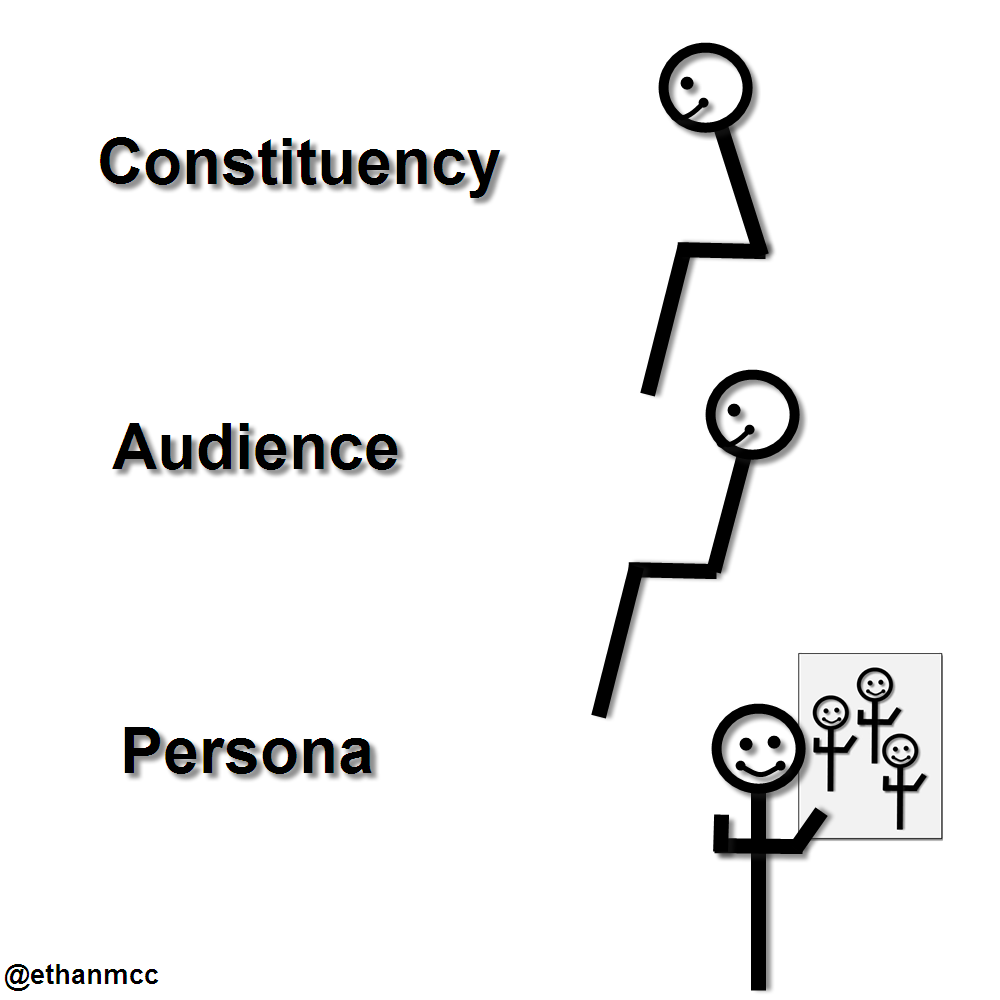
Constituency, audience, persona www.ethanmccarty.com @ethanmccSocial business marketing — and, well, marketing and communications in general, really — starts with people.  As in, who are you trying to reach? What do you know about them?  What do they want to do?  What do you want them to do/believe/understand/buy?

Since the point of departure is understanding selected groups of people, we often start our marketing and communications plans with some kind of description of the people we’d like to engage.  And recently, there’s been a lot of discussion in my world about three different ways of describing people — audiences, constituencies and personas.  I’d like to offer my understanding of these three terms and see what others think.  Again, this is all in the context of marketing and communications, but I’d be interested as well to know if other disciplines or industries have attached other meanings to these words (or words like them).

Audience: An audience is a group of people who may have nothing in common with one another other than the fact that they are all consuming the same piece of content.  I like to think of this as a fairly passive grouping of people since they may not know each other or want to know each other at all.  Just like when you see a movie — thousands of other people may see the same movie (some of them may even be in the same room with you) but you may have little in common with them beyond some demographic similarities.  These similarities can be, however, very powerful for the marketer — the simple fact that you are sitting in front of that particular piece of content can say a lot about you, for example some of your interests, your approximate income level, the language you speak and the region you live in etc.

Constituency: A constituency is an activated group of people with shared ambitions, objectives and/or pain points – they self-identify with a cause or a shared belief and seek change.  While they may have certain demographic similarities among them, these similarities are not a constituency’s defining characteristic.  Instead, it is a psychographic profile that unites a constituency.  The term constituency  is, of course, borrowed from democratic representative politics where elected representatives go to congress or parliament to represent the needs and desires of the people back home who share a common need to see certain things about their lives changed through legislation.  In the world of increasingly personalized and intimate marketing and communications, it can be incredibly powerful to understand which constituencies will most likely affect your organization.  I find it helpful to think of audiences as leaning back & receiving compared to constituencies leaning forward & acting.

Persona:  Personae are useful when planning a marketing and communications program because they allow you to extrapolate from a representative example how you think groups of people might believe.  A persona is essentially a composite of an audience or a constituency wrapped up in one or two people.  So you can create a fictional representative of a certain audience or constituency to run through various scenarios.  It’s helpful to use personae to test your thinking — would a gum-chewing, Facebook’ing, metal-head teenager actually want to learn more about how your Enterprise CRM can transform society?  Um, maybe not.  My colleague, Priya Varadachary, helpfully describes personae this way, “Personae align the content and experiences with key needs and digital behaviors to build a customer model. This means learning and documenting how our targets behave in the digital context (which should then influence usage data, lifestyle need states, device penetration, personas, usability, multivariate testing etc).”

So, as you can see, I don’t view these three terms as mutually exclusive or in competition.  They are just three different ways to think about groups of people when doing your marketing and communications planning.  I’d be interested to hear if you have other ways of thinking about groups of people or if there are nuances here that could be better unpacked or described.

A couple 2012 resolutions

I had my first video conference of the year with my team this week and shared with them a few resolutions for my professional life.  After reading Jeremy Hodge’s post along a similar line I thought I’d put them up too (particularly since they are so similar…I can clip from his post!)

The main one I’d like to commit to is to send (and hopefully, therefore, receive) less email.  One of the main ways I figure I can do this is to make much better use of IBM’s internal collaboration system, IBM Connections.  It is, afterall, now fully deployed at IBM and all my colleagues have access to it.  Sure, we’ve had it up and running for a long time (including in prototypical states like a decade ago) but at this point it’s really gained critical mass.  Even our new CEO, Ginny Rometty is using it.

I also really liked the article “Work Smart: Disrupt your Inbox” that Jeremy referenced in his post.  It has a few simple guidelines that would make the world a much less stressful place if we all followed them.  Here they are:

Experiment with three-sentence emails for a better response rate.
Start with action-oriented steps, don’t leave them at the bottom of the email.
Market your subject lines–make them an advertisement to open and read the email.
Take disagreements offline.
Don’t “reply all” unless everyone needs to be involved.
Use numbers for reference in back-and-forth correspondence to reduce redundancy and length.

I would add, “Put NRN” at the end of emails that are “no reply necessary.”  And, “stop thanking people in separate emails.”

The other resolution I want to make for 2012 can also be found in Jeremy’s post.  No, I’m not going to attempt to learn any more code than I know already (well, actually…maybe I will…I am kinda inspired by the idea and the little bit of coding I learned over the years in HTML and XML has served me very well….hmmm.)  But seriously, the resolution is to limit multitasking This will, no doubt, prove very tough — it’s basically expected that IBMers (tech/marketing people in generally, I bet) are “expert multitaskers.”  We probably are, if an expertise can actually be described this way: being the best at doing something that makes you dumb. Claiming expertise at multitasking is a little bit like saying you’re an expert at huffing gasoline.

Minimizing multitasking is going to be tough for a lot of reasons — for one, it means I’m going to have to decline or delay a lot of meetings.  It will also mean I will schedule more time for individual tasks, which is tough to do in an organization that assumes that everyone is “pingable” on chat 24/7.  But I am gonna give it a go.  I have to.

So that’s my thought for professional resolutions for 2012.  Maybe more will come to mind, but if I can make those two happen I think I can expect a much more productive and sane year.

Big Blue is the antithesis of Big Brother. It’s ‘Big Open’

Not that anyone asks me anymore why I work for IBM, but this article in Business Insider by Mark Fidelman pretty much nails it.  Basically the thesis is that open, collaborative organizations are the way of the future and fear-driven, dictatorial organization are gonna go the way of the do-do.  Now, IBM isn’t perfect, but there aren’t many other organizations in the world that can actually claim that they are, in fact, actively working to mold their organizational culture in this way. 

Not only that, but the article lays out the business benefit, “IBM has been so successful in its last few years, that it’s outperformed the S&P 500, Hewlett Packard, Microsoft, Google and Oracle.”

There’s also some nice, tidy philosophical underpinnings explained.  Here is a selection of my fave quotes from the piece.

“While Apple has been wildly successful, IBM’s Social Business is much more attainable and sustainable than what Fortune’s Adam Lashinsky describes as Apple’s genius led, culture of fear. For the genius is always, as Benjamin Disraeli and later Peter Drucker predicted, succeeded by a “lieutenant of Marines” who understands the business but nothing else. So the company is only left with an innovation vacuum.”


“Work creates a unique social bond – it is the interface between people, technology and culture. Work’s social bond must also evolve. It must responds to market conditions and customer demands. There isn’t a large company that does this better than IBM.
It may be too early for some organizations to come to grips with social business as a strategy. They are stuck in a corporate dystopia, ruled by the equivalent of an Orwellian inner party which condemns individuality and transparency as thought crimes.”


Why Every Company Needs to be More Like IBM & Less Like Apple ow.ly/8hWP4

The main interesting thing to me about A

The main interesting thing to me about Apple’s recently leaked social media guidelines is that they are titled “retail” guidelines — which begs the question: do they have different guidelines for different areas of their business? Also, they seem pretty standard issue (e.g. they more or less step in a footprint IBM made in early 2006.) Read ’em here. http://ow.ly/7Pmcn